For full list of publications, please visit Google Scholar
- Prior to UA
- 2024
- Bai, Yeran, Carolina M. Camargo, Stella MK Glasauer, Raymond Gifford, Xinran Tian, Andrew P. Longhini, and Kenneth S. Kosik. “Single-cell mapping of lipid metabolites using an infrared probe in human-derived model systems.” Nature Communications 15, no. 1 (2024): 350.

- Guo, Zhongyue, Bai,Yeran, Pereira, Fátima C., and Cheng, Ji-Xin. “Optical Photothermal Infrared-Fluorescence In Situ Hybridization (OPTIR-FISH).” Journal of visualized experiments: JoVE 204 (2024): 10-3791. 🔗
- Longhini, Andrew P., Austin DuBose, Samuel Lobo, Vishnu Vijayan, Yeran Bai, Erica Keane Rivera, Julia Sala-Jarque et al. “Precision proteoform design for 4R tau isoform selective templated aggregation.” Proceedings of the National Academy of Sciences 121, no. 15 (2024): e2320456121. 🔗
- Bai, Yeran, Carolina M. Camargo, Stella MK Glasauer, Raymond Gifford, Xinran Tian, Andrew P. Longhini, and Kenneth S. Kosik. “Single-cell mapping of lipid metabolites using an infrared probe in human-derived model systems.” Nature Communications 15, no. 1 (2024): 350.
- 2023
- Astratov, Vasily N., Yair Ben Sahel, Yonina C. Eldar, Luzhe Huang, Aydogan Ozcan, Nikolay Zheludev, Junxiang Zhao et al. “Roadmap on label‐free super‐resolution imaging.” Laser & photonics reviews 17, no. 12 (2023): 2200029. 🔗
- Guo, Zhongyue, Yeran Bai, Meng Zhang, Lu Lan, and Ji-Xin Cheng. “High-throughput antimicrobial susceptibility testing of Escherichia coli by wide-field mid-infrared photothermal imaging of protein synthesis.” Analytical Chemistry 95, no. 4 (2023): 2238-2244.
- Prater, Craig, Yeran Bai, Sabine C. Konings, Isak Martinsson, Vinay S. Swaminathan, Pontus Nordenfelt, Gunnar Gouras, Ferenc Borondics, and Oxana Klementieva. “Fluorescently guided optical photothermal infrared microspectroscopy for protein-specific bioimaging at subcellular level.” Journal of medicinal chemistry 66, no. 4 (2023): 2542-2549. 🔗
- Bai, Yeran, Zhongyue Guo, Fátima C. Pereira, Michael Wagner, and Ji-Xin Cheng. “Mid-Infrared Photothermal–Fluorescence In Situ Hybridization for Functional Analysis and Genetic Identification of Single Cells.” Analytical Chemistry 95, no. 4 (2023): 2398-2405. 🔗
- 2021
- Yin, Jiaze, Lu Lan, Yi Zhang, Hongli Ni, Yuying Tan, Meng Zhang, Yeran Bai, and Ji-Xin Cheng. “Nanosecond-resolution photothermal dynamic imaging via MHZ digitization and match filtering.” Nature Communications 12, no. 1 (2021): 7097. 🔗
- Zong, Haonan, Celalettin Yurdakul, Yeran Bai, Meng Zhang, M. Selim Unlu, and Ji-Xin Cheng. “Background-suppressed high-throughput mid-infrared photothermal microscopy via pupil engineering.” ACS photonics 8, no. 11 (2021): 3323-3336. 🔗
- Yurdakul, Celalettin, Haonan Zong, Yeran Bai, Ji-Xin Cheng, and M. Selim Ünlü. “Bond-selective interferometric scattering microscopy.” Journal of Physics D: Applied Physics 54, no. 36 (2021): 364002. 🔗
- Bai, Yeran, Jiaze Yin, and Ji-Xin Cheng. “Bond-selective imaging by optically sensing the mid-infrared photothermal effect.” Science Advances 7, no. 20 (2021): eabg1559. 🔗
- Zong, Cheng, Chi Zhang, Peng Lin, Jiaze Yin, Yeran Bai, Haonan Lin, Bin Ren, and Ji-Xin Cheng. “Real-time imaging of surface chemical reactions by electrochemical photothermal reflectance microscopy.” Chemical Science 12, no. 5 (2021): 1930-1936. 🔗
- 2019
- Zhang, Delong, Lu Lan, Yeran Bai, Hassaan Majeed, Mikhail E. Kandel, Gabriel Popescu, and Ji-Xin Cheng. “Bond-selective transient phase imaging via sensing of the infrared photothermal effect.” Light: Science & Applications 8, no. 1 (2019): 116.🔗
- Li, Xiaojie, Delong Zhang, Yeran Bai, Weibiao Wang, Jingqiu Liang, and Ji-Xin Cheng. “Fingerprinting a living cell by Raman integrated mid-infrared photothermal microscopy.” Analytical Chemistry 91, no. 16 (2019): 10750-10756. 🔗
- Bai, Yeran, Delong Zhang, Lu Lan, Yimin Huang, Kerry Maize, Ali Shakouri, and Ji-Xin Cheng. “Ultrafast chemical imaging by widefield photothermal sensing of infrared absorption.” Science Advances 5, no. 7 (2019): eaav7127.
- 2017
- Bai, Yeran, Delong Zhang, Chen Li, Cheng Liu, and Ji-Xin Cheng. “Bond-selective imaging of cells by mid-infrared photothermal microscopy in high wavenumber region.” The Journal of Physical Chemistry B 121, no. 44 (2017): 10249-10255. 🔗
- Bai, Yeran, Suhas Vettil, Xingchen Pan, Cheng Liu, and Jianqiang Zhu. “Ptychographic microscopy via wavelength scanning.” APL Photonics 2, no. 5 (2017). 🔗
- 2024

Single-cell mapping of lipid metabolites using an infrared probe in human-derived model systems
- High Specificity Imaging: The platform enables direct imaging of lipid metabolism with high specificity in various human-derived 2D and 3D models.
- Infrared Probe Utilization: It employs an infrared probe to map lipid metabolites
- Single-Cell Resolution: The technique allows for metabolic imaging at the single-cell level, providing insights into cellular heterogeneity.
- Potential Applications: This method could advance understanding of lipid metabolism in health and disease, aiding in the development of targeted therapies.

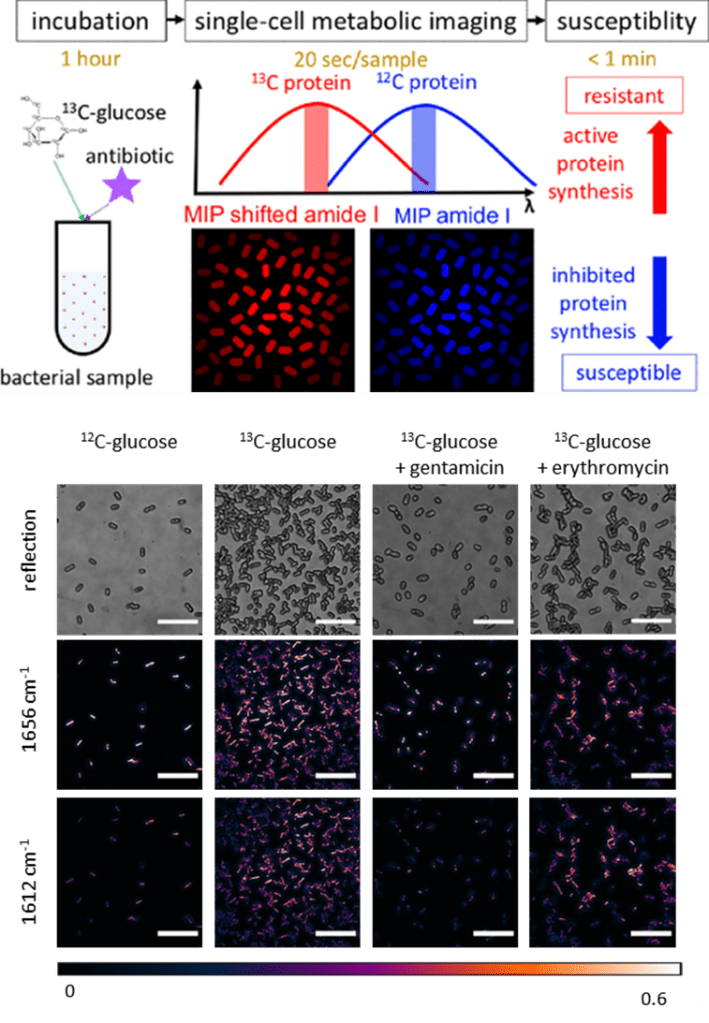
High-throughput antimicrobial susceptibility testing of Escherichia coli by wide-field mid-infrared photothermal imaging of protein synthesis
- Rapid AST: Reduces the time needed for antimicrobial susceptibility testing down to one hour, enabling faster diagnostics.
- 13C-glucose tracking: Monitors antibiotic impact by detecting 13C-labeled glucose incorporation into bacterial proteins.
- High-Throughput & Single-Cell Resolution: Through multiple technological developments, we can analyze hundreds of bacteria simultaneously in seconds.


Ultrafast chemical imaging by widefield photothermal sensing of infrared absorption
- Widefield Mid-Infrared Photothermal Microscope: We achieve up to 1250 frames per second imaging speed while maintaining sub-micrometer spatial resolution and high spectral fidelity.
- Introducing Virtual Lock-In Technique: We carefully design the detection mechanism using time-gated measurements to extract signals, enabling time-resolved imaging of photothermal processes.
- Demonstration of Thin-Polymer Pattern and Live-Cell Imaging: We showcase high-speed imaging at a few Hz, significantly improving upon previous scanning-based methods.

 Biomedical Applied Imaging Lab